
 Free Shipping in US
Gel Seat Cushion for Tailbone Pain: How It Works and Who It Helps
Quick answer: A gel seat cushion with a coccyx cut-out helps tailbone pain by taking pressure off the coccyx while you sit. The memory foam spreads your weight across your thighs and buttocks, and the gel layer on top keeps the surface cooler during long sitting sessions. For most people with sitting-related tailbone or lower back discomfort, it is one of the simplest first steps to try.
Americans sit more than ever. A 2019 study in JAMA found that daily sitting time for US adults rose from 5.5 hours to almost 6.5 hours between 2007 and 2016 (Yang et al., JAMA 2019). At the same time, low back pain affected an estimated 619 million people worldwide in 2020, and the World Health Organization calls it the single leading cause of disability (WHO).
If you spend your day at a desk, in a car or in a wheelchair, the surface you sit on matters. This guide explains how a gel seat cushion works, who it helps most, how to sit on it correctly and how it compares with a standard memory foam cushion.
Why sitting makes tailbone pain worse
The tailbone (coccyx) is the small, triangular bone at the very bottom of your spine. When you sit upright, part of your body weight rests on it. On a hard or flat seat, that pressure is concentrated on a small area.
Tailbone pain, known medically as coccydynia, is most often caused by a backward fall, a difficult childbirth or repetitive sitting on hard surfaces. A review in The Ochsner Journal lists obesity and female gender as risk factors, with women about five times more likely than men to develop it (Lirette et al., 2014).
The good news: the same review reports that conservative treatment is successful in 90% of cases. One of the conservative options it names is a wedge-shaped coccygeal cushion, which “can relieve the pressure on the coccyx while the patient is seated.”
How a gel seat cushion works
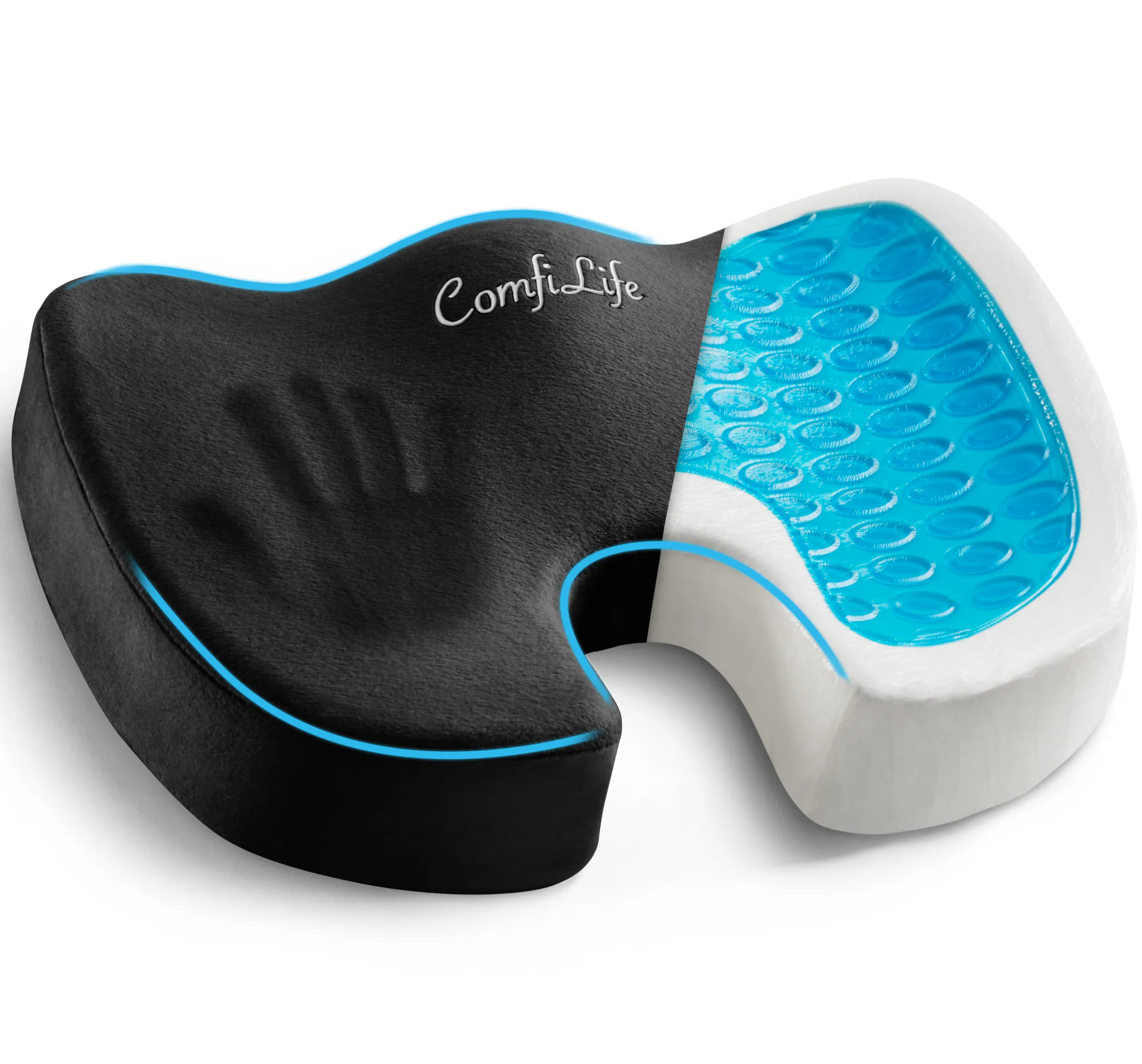
A gel seat cushion such as the ComfiLife Gel Enhanced Seat Cushion combines three features:
- A U-shaped coccyx cut-out. The open space at the back means your tailbone does not press into the cushion. Your weight shifts to the thighs and buttocks instead.
- High-density memory foam. The foam contours to your shape and spreads pressure over a larger area. This helps with tailbone pain, sciatica and lower back discomfort from long sitting.
- A gel layer on top. Memory foam can trap body heat. The gel layer adds a cooling effect, so the surface feels more comfortable during long workdays or drives.
The ComfiLife cushion also has a non-slip rubber bottom, a built-in carry handle and a machine-washable zippered velour cover. It measures 17.6 x 13.8 x 2.75 inches and weighs 2.05 pounds.
Who a gel seat cushion helps most
- Office workers who sit for 6+ hours a day on a firm or worn-out chair.
- Drivers and commuters who feel tailbone or lower back pressure on long drives.
- People recovering from a tailbone injury or a fall, once a doctor has cleared them.
- New mothers with tailbone pain after childbirth.
- People with sciatica or herniated discs who need to reduce pressure while seated.
- Wheelchair users who want more even pressure distribution.
- Gamers, students and remote workers who spend long hours at a desk.
How to sit on a gel seat cushion correctly
- Place the cushion on your chair with the cut-out facing the back of the seat.
- Sit all the way back so your tailbone lines up with the open cut-out.
- Keep your feet flat on the floor and your knees at about hip level. If your chair is now too high, lower it slightly.
- Pair it with a lumbar pillow if your chair lacks lower back support.
- Stand up and move every 30 to 60 minutes. A cushion reduces pressure, but it does not replace movement.
Tip: A new memory foam cushion can have a mild smell at first. This is normal; leave it in a well-ventilated room for a day or two.
Gel vs. standard memory foam seat cushion
| Feature | Gel-enhanced memory foam | Standard memory foam |
|---|---|---|
| Pressure relief | Same contouring support | Same contouring support |
| Surface temperature | Cooler, thanks to the gel layer | Can feel warm over time |
| Best for | Long workdays, warm climates, people who run hot | Shorter sitting sessions, cooler rooms |
| Coccyx cut-out | Yes (ComfiLife Gel Enhanced) | Yes (ComfiLife Premium Comfort) |
Both ComfiLife cushions perform similarly for support. The main difference is the cooling effect of the gel layer. Choose gel if you tend to feel hot when you sit for long periods. For more options, see our seat cushion buying guide.
When to see a doctor
A seat cushion is a comfort aid, not a medical treatment. See a doctor if your tailbone pain lasts more than a few weeks, follows a hard fall, or comes with numbness, fever or bladder and bowel changes. For more tips, read our guide to tailbone pain relief.
Frequently asked questions
Does a gel seat cushion really help tailbone pain?
Yes, for most sitting-related tailbone pain. The coccyx cut-out removes direct pressure from the tailbone, and medical reviews list coccygeal cushions as a standard conservative treatment (Lirette et al., 2014).
Is gel better than memory foam for a seat cushion?
Both give the same contouring support. Gel-enhanced memory foam adds a cooling layer on top, which helps if you sit for many hours or tend to feel warm.
Which way should the cut-out face?
Toward the back of the chair. Sit all the way back so your tailbone lines up with the opening.
How much weight can the ComfiLife Gel Enhanced Seat Cushion hold?
The maximum recommended weight is 250 lbs. Memory foam is heat and weight sensitive, so it gives less support as weight increases.
Can I use it in the car or a wheelchair?
Yes. The non-slip bottom keeps it in place on office chairs, car seats and wheelchairs. Avoid leaving it in a hot car for long periods, because memory foam responds to heat.
How do I clean it?
Unzip the velour cover and machine wash it. Do not wash the foam core.
Sources
- World Health Organization. Low back pain fact sheet, June 2023.
- Yang L. et al. Trends in Sedentary Behavior Among the US Population, 2001-2016. JAMA, 2019;321(16):1587.
- Lirette L.S. et al. Coccydynia: An Overview of the Anatomy, Etiology, and Treatment of Coccyx Pain. The Ochsner Journal, 2014;14(1):84-87.
This article is for general information and is not medical advice.


Add comment
You must be logged in to post a comment.